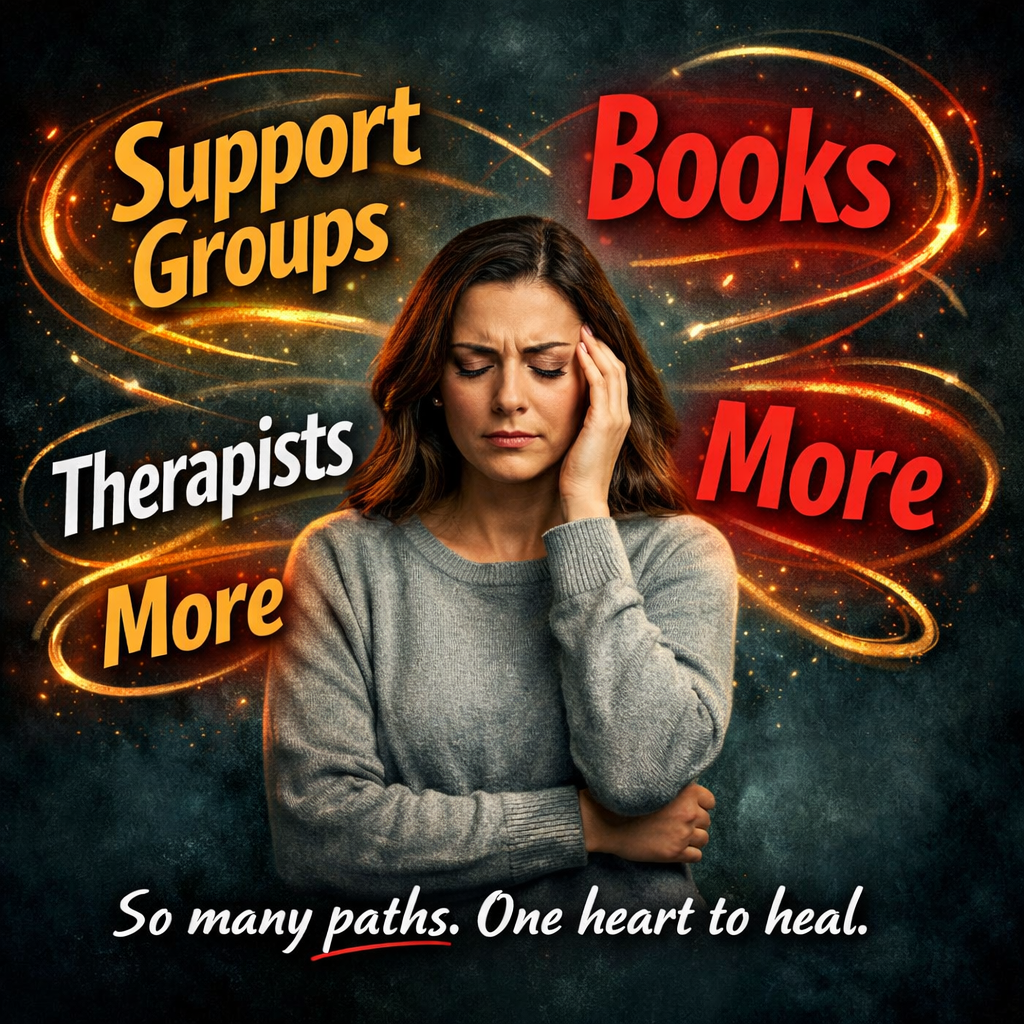
Betrayal trauma healing can be very overwhelming, especially at the beginning. You are probably drowning in pain you didn’t ask for or deserve. However, you are desperate for any tool that can ease what you are experiencing. There are books to read, podcasts to listen to or watch, and meetings to attend that can help you heal. But what do you do when you don’t agree with everything? Are you supposed to digest everything available to you, despite any misgivings you may have? You can be discerning while seeking healing resources that best address YOUR healing needs.
When I first heard someone say “Take what applies to you and throw out the rest” as it relates to betrayal trauma healing resources, I was so relieved. There was quite a bit I was hearing and reading that I either didn’t agree with or didn’t apply to my specific situation. As much as I appreciated the wealth of resources available to me, I knew digesting everything wasn’t going to get me to where I wanted to be in my healing. I started focusing on what would specifically help me on my healing journey versus viewing every suggested resource as a necessity.
S-ANON
I am very familiar with some of the complaints regarding S-ANON. Some betrayed partners don’t like to attend meetings because the term “high power” is used instead of a specific faith. Others assume S-ANON is for the partners of serious sex addicts, and finally, people don’t like the “the partner is sick too” approach, especially as it relates to codependency.
“Higher Power”
I relied heavily on God while I healed from betrayal trauma and still do. The use of “higher power” in meetings or literature was not an issue for me. I knew who my higher power was; I could not be convinced otherwise. I had no problem letting others know what my religious beliefs were after the meeting. If there was an opportunity to mention my faith in a share, I took advantage of it.
There is nothing like witnessing people come to S-ANON without faith, but eventually come to believe in spirituality. This might not have happened if S-ANON members pushed their own faith on others or made it a requirement for membership. I have had people approach me after the meetings about my faith and what I believe because of something I shared.
“S-ANON is for the partners of hardcore sex addicts.”
I, too, had this mindset. Therefore, once I received a disclosure, I told myself, “I guess I need to go to S-ANON meetings based on what I now know about my husband’s addiction.” So, I put my tail between my legs and showed up to my first S-ANON meeting 48 hours after receiving a disclosure. Although I went because of what my husband shared in his disclosure, I realized I needed to be there because of the impact his addiction was having on me, not the details of his acting-out behavior. Today, I believe S-ANON is about helping people heal from the effects of sex addiction regardless of what the actual “acting out” behavior is.
“Co-dependency”/ You are sick.
This was the hardest part of S-ANON for me to work around because I didn’t see myself as sick. I did not believe I was destined to end up with a sex addict because of the way I was wired. Nor was I willing to take the blame for my husband’s poor choices. So, I began highlighting the parts in S-ANON literature that pertained to my situation.
The key for me was focusing on all I could gain from attending structured meetings, practicing slogans, reading the devotionals, completing the steps, getting a sponsor, and actively participating. Letting the tiny percent I didn’t agree with keep me from the benefits of S-ANON would have been a huge loss for my healing. I know S-ANON is not perfect, but focusing on the parts I found helpful for my healing was a good choice for me.
Faith-based support groups
I attended a faith-based support group for a while. There was a particular book I really liked, but there was a chapter I did not agree with; everything else was right in line with what I needed at the time. I was able to mark that section of the book out and continue reading the information, which was incredibly helpful. My need for a faith-based group helped me cling to God more than ever. The group became a bible study for me at the time. I was not going to let one chapter of a large book keep me from getting what I needed.
Codependency Support Groups
I attended a codependency support group facilitated by my therapist with skepticism. This group was a great opportunity to learn about codependency, so I could stay aware of whether I exhibited codependent behavior in relationships in my life, not just my marriage. We would all share something we were dealing with and receive feedback from others regarding whether our management of the issues was codependent. I liked getting feedback from others and their perspective on my shares.
Ironically, I got more out of this group as it related to my children because some of the women had older children who experienced the same challenges I was dealing with at the time. These women offered feedback regarding whether I was parenting from codependency or not. I was able to identify codependency in family members and friends I interacted with. Furthermore, I became alert about codependency in myself as I interacted with others.
Today, I can talk openly about codependency with my adult children as it relates to their friendships and dating, an unexpected gift from the group I almost didn’t attend.
Books
Reading many books about betrayal trauma healing was easy for me. However, if there was something I did not agree with or did not seem helpful to my situation, I just crossed out sentences or put a huge “X” on paragraphs. I was looking for books that realistically addressed the emotions I felt and the ups and downs of the healing process. Books with flowery language regarding betrayal trauma that minimized what I was experiencing did not appeal to me. Nor did I want to read books that examined “why I was in a relationship with a sex addict”, how to fix the sex addict, or how to fix my marriage.
I learned I liked the structure of workbooks and the opportunity they provided to write my thoughts on paper. Today, I try to stay on top of healing books and workbooks for my own knowledge. A part of me is always curious about new books that come out and whether they are helpful.
Therapist
When I started seeing my second therapist, she talked about codependency in our first appointment. I quickly told her I did not want to focus on codependency. I shared my thoughts on codependency and the previous work I did around the issue, making it clear my purpose in seeing her was to focus on continuing my betrayal trauma healing and arriving at a place of peace on my journey.
Additionally, if my therapist misunderstood something I said or she assumed based on her other clients, I would clarify my thoughts so she would clearly understand my perspective. If she refused to honor my wishes, I would have sought a different therapist.
Just because you expose yourself to certain tools in your healing means doesn’t mean you have to digest everything. This is similar to grocery shopping (sort of); you do not buy everything on the shelf; you look at the items and select what you want based on price, dietary restrictions, nutritional value, how you plan to use the grocery items, etc. Betrayed partners have different situations and healing needs, which should be taken into consideration when seeking resources. Criteria can also help betrayed partners dissect the parts of the resources that make sense for them.
The list below is of concerns I had, which I sought resources for after receiving my husband’s disclosure.
- I was experiencing PTSD and pain.
- I felt a profound sense of betrayal and victimization.
- I did not trust myself to make good decisions.
- I wanted to learn about sex addiction.
- I needed to cling to my faith.
Additional factors some betrayed partners contemplate when selecting resources that can help them heal in their specific situation:
- If the acting out involved their children or others.
- Did the sex addict receive legal punishment?
- Are there other addictions present? (gambling, alcoholism, etc.)
- Their own guilt (i.e., previously forgiving, your own infidelity, how you enabled the addiction, childhood influence, etc.)
- Age of their children and how this might impact them if they know about the addiction.
- The amount of time the sex addict was in active addiction.
- How the addiction escalated and the worst of the acting-out behaviors.
- Faith
- Financial situation
- How many times have they been on the ‘I forgave, but my addict is at it again” roller coaster?
Your healing needs may change over time, so the resources you start out using may change. You can always make adjustments to your healing journey. Asking yourself the following questions from time to time might assist you when deciphering which tools to use or which parts of the tools are most beneficial to your healing:
- Is this resource doing more harm than good?
- Is this resource still helping me heal from betrayal trauma, or do I need something else that aligns with where I am today?
- Do I feel better after using the resource, or do I feel angry, attacked, ignored, etc.?
- Can I get what I’m looking for in the resource by focusing on how the information pertains to my situation?
With time and a little more healing under my belt, I also needed resources to help me with the following:
- Help me envision what I wanted for myself moving forward, whether I stayed married or not.
- Help me decide what I want for marriage if I choose to stay.
- I wanted to know what I did to enable the addiction so I wouldn’t ever do it again.
- I didn’t want to lose myself; I wanted to embrace the new version of myself. Accepting that my journey was changing me.
- I wanted to be a better parent, not letting what I was experiencing decrease my parenting abilities.
- Avoid becoming bitter and resentful.
- Heal well, so I could still experience joy in my life and be joyous around others.
- I didn’t want this experience to destroy me.
Many of the resources I used at the beginning of my journey are still part of my healing lifestyle today because they still meet my needs. The key is knowing what you need now and adjusting if necessary.
Don’t let the tiniest part of a resource that gets under your skin keep you from enjoying the majority of what you can gain. If a book is more helpful than not, consider continuing to read it. If a support group helps more than it hurts, consider continuing to attend. You can experiment with a variety of resources while staying aware of your healing needs. If you don’t know what your healing needs are, time will reveal this to you. Furthermore, it’s also okay to recognize something isn’t working for you anymore.
There is beauty in knowing what is available and which part of the resources you select can assist you in YOUR HEALING JOURNEY. You can be curious while discerning as you heal. Hopefully, choosing and dissecting your healing tools will be empowering versus overwhelming – YOU CAN TAKE WHAT APPLIES TO YOU AND THROW OUT THE REST!